
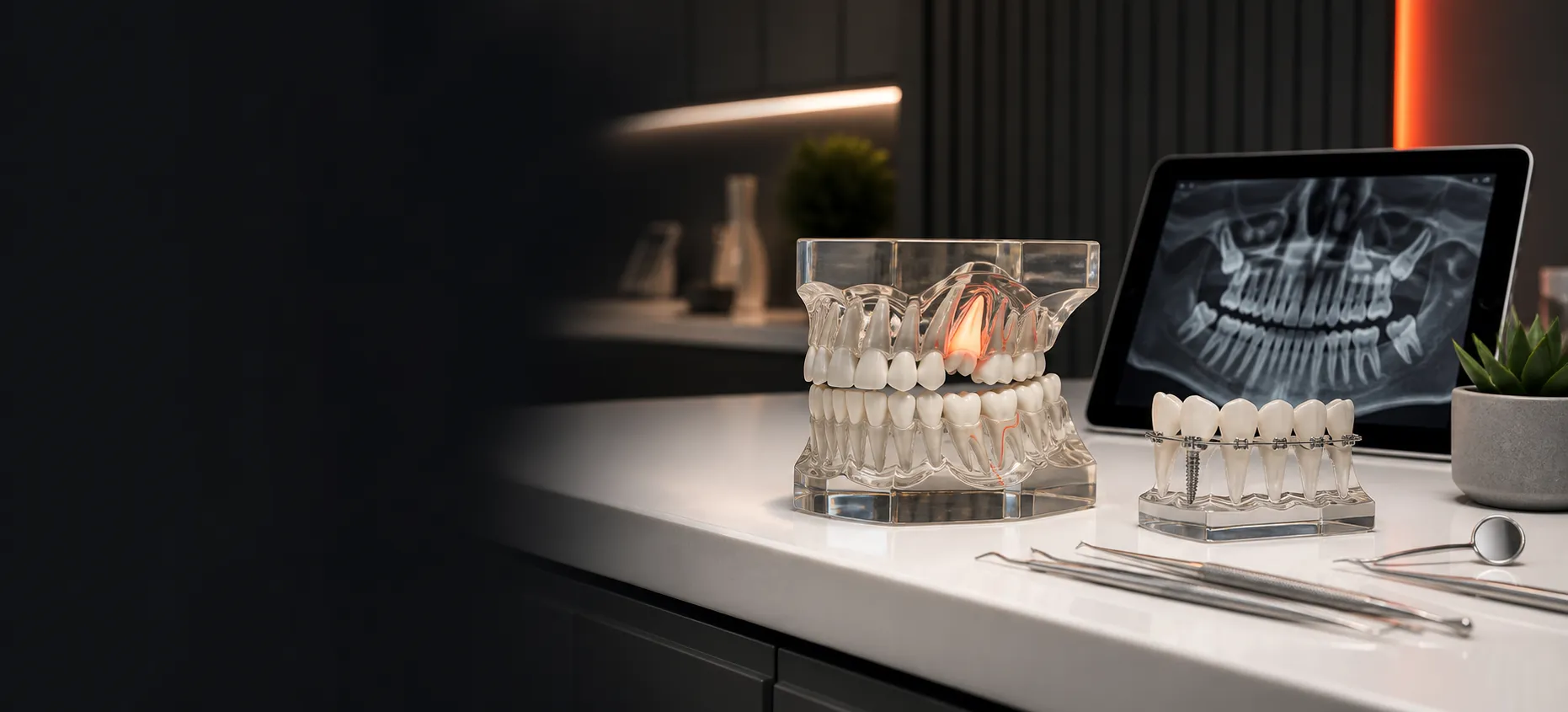
When a patient is told an impacted tooth must be extracted, a second opinion is often worth seeking. In many cases an impacted tooth can be guided into its correct position instead of removed.
What is an impacted tooth?
An impacted tooth is one that cannot fully erupt through the gum on its own — it may be blocked by adjacent teeth, bone, or soft tissue. Wisdom teeth are most commonly impacted, but canines and other teeth can be affected too. Left untreated, an impacted tooth can create problems for neighboring teeth.
How guided eruption works
- Imaging, such as a cone-beam CT scan, confirms the tooth's exact position.
- A minor surgical procedure exposes the tooth, and a small orthodontic bracket is attached.
- A temporary anchorage device (TAD) — a tiny titanium screw — provides a stable anchor point.
- Gentle, controlled force guides the tooth into the arch over several months.
- Once it reaches position, the TAD is removed and final alignment is completed.
Why coordinated, multi-specialty care matters
These cases require orthodontics and oral surgery or periodontics to work together. At Sonrisas, those specialists collaborate under one roof, which keeps planning and treatment coordinated for the patient.